
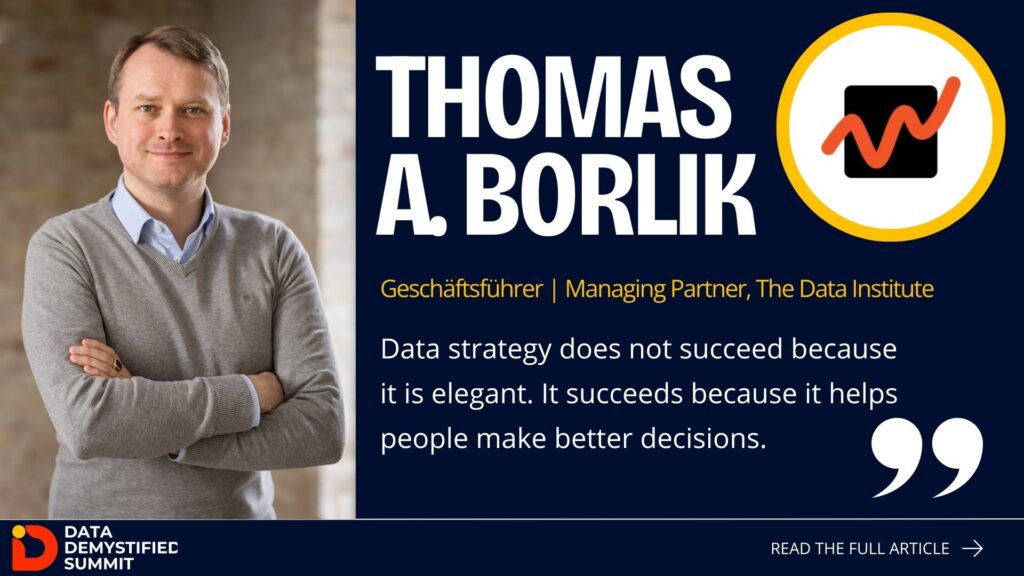
Many small and mid-sized companies say they want to “do more with data.” What they often mean is something far simpler and more practical: fewer decisions based purely on intuition, less friction between teams, and greater confidence that everyone is working from the same understanding of the numbers. In this thoughtful piece, Thomas A. Borlik from The Data Institute explores what a data strategy truly means in practice. Rather than focusing on tools or complex architecture, he highlights the importance of clarity, alignment, and organisational habits that allow data to support better decisions across the business. Welcome Thomas A. Borlik, sharing his insights in the Data Demystified Thoughts series.
Data Strategy Done Right: How SMEs Turn Data into Real Decisions
Many small and mid-sized companies say they want to “do more with data.”
What they usually mean is not another dashboard or a new tool, but something far more basic: fewer gut decisions, less friction between teams, and more confidence that the numbers discussed in meetings actually mean the same thing to everyone in the room.
What they often get instead is the opposite. New tools are introduced, reporting grows more complex, and yet the feeling remains that decisions are not getting easier. People are busy, but direction is missing. At that point, data starts to feel like an additional burden rather than a support system.
This is usually the moment when someone suggests that “we finally need a proper data strategy.” And almost immediately, expectations diverge. Some imagine a comprehensive roadmap. Others expect a target architecture. Some hope it will finally unlock AI. Many secretly fear another document that looks good but changes very little.
In practice, a good data strategy is none of those things—and a bit of all of them. Most importantly, it is not a one-off exercise. It is a living frame of reference that helps an organisation orient itself, especially when decisions are uncomfortable or unclear.
Seeing Yourself More Clearly
Let me address the obvious objection early: “Sure, the external advisor says we need an external view.”
Fair enough.
The reason an external perspective helps is not superior intelligence or secret methods. It helps because every organisation develops its own internal logic over time. Decisions accumulate, workarounds become normal, definitions harden. None of this is wrong—but it becomes invisible from the inside.
When an outsider asks simple questions – Why is this KPI calculated differently across teams? Who actually decides when definitions change? What problem is this tool supposed to solve? – It often creates mild irritation. That irritation is usually a sign that something important is being touched.
In one engagement, for example, a data platform implementation only succeeded after a seemingly banal issue was addressed: KPI alignment. Nearly twenty different revenue metrics existed, all valid in their own context, all regularly mixed up. Agreeing on definitions and nomenclature was not glamorous work, but it changed everything. Once clarity existed, technology could finally do its job.
External input is not about replacing internal knowledge. It is about challenging assumptions before they turn into expensive commitments.
Data Strategy Lives in Three Dimensions
Another recurring pattern is the tendency to reduce data strategy to architecture. Cloud or on-prem. Warehouse or lake. Tool A or tool B. Those decisions matter—but they are only one part of the picture.
Sustainable data work always unfolds across three dimensions at the same time: technology, organisation, and culture. You may encounter different labels for these dimensions, and the boundaries between them are rarely clean. If that makes you slightly uncomfortable, that’s okay. Just keep in mind that data work is inherently multidimensional. Reducing it to a single lens—usually technology—almost always leads to blind spots elsewhere.
Technology defines what is possible. An organisation defines who decides and who owns outcomes. Culture determines whether data is actually used, trusted, and challenged. Ignoring one of these dimensions will eventually undermine the others.
At the same time, treating all three as equally urgent from day one is rarely helpful. Some organisations are held back by outdated platforms. Others have surprisingly robust setups but struggle with ownership and governance. A good data strategy does not impose symmetry where none exists. It acknowledges imbalance and addresses it deliberately.
This is one of the areas where experience—and sometimes external perspective—makes a real difference. Not everything has to be fixed at once. But the interdependencies need to be understood from the start.
Starting Small Is Not a Weakness
One of the most damaging myths around data strategy is that it requires a grand plan before anything can happen. Five-year roadmaps, fully staffed data organisations, perfectly aligned target states. In reality, those ambitions often delay progress rather than enable it.
What works far better is starting with a limited scope and clear intent.
In one of our strategy projects—what we sometimes refer to as a data audit—the entire initial phase lasted just a single week. A one-day workshop brought together around ten people from different parts of the organisation. The agenda was intentionally simple: What works well today? What does not? And what would you change if time and budget were no constraints?
That was it. No tools, no architecture slides, no promises. Yet this conversation created enough shared understanding to trigger a broader initiative later on—one that included building a central data platform and rethinking organisational responsibilities. Not because someone presented a perfect solution, but because clarity emerged where confusion had existed before.
Starting small does not mean thinking small. It means creating momentum without overengineering the first step. In this context, the earlier-mentioned external perspective proved particularly valuable—not to dictate outcomes, but to help steer discussions, surface implicit assumptions, and reduce friction during the workshop itself.
Listening Before Designing
Before any roadmap is drawn or platform discussed, there is one activity that consistently pays off : listening.
Explorative interviews are not about validating a preconceived strategy. They are about understanding what people actually care about, what frustrates them, and where they feel uncertain. These conversations often drift away from data—and that is precisely their value.
When people talk about their daily work, you learn which decisions feel risky, which meetings are unproductive, and which metrics nobody trusts. You also learn where data can genuinely help—and where introducing it would only add noise.
Skipping this step almost guarantees misalignment later on. Solutions get imposed, resistance grows, and data becomes something that is “done to” the organisation rather than developed with it.
Transparency Is Not a Soft Topic
If data strategy has a foundational principle, it is transparency.
Many organisations still operate with management habits that limit information to what feels strictly necessary. Not only in data initiatives does this approach backfire quickly. People sense when decisions are made elsewhere, when priorities shift without explanation, or when numbers are used selectively.
Transparency does not mean oversharing or chaos. It means being open about goals, constraints, trade-offs, and even uncertainty. It means involving people early, explaining why decisions are made, and trusting teams with responsibility rather than just tasks.
Where transparency is missing, identification suffers. And without identification, performance follows suit.
Strategy Cascades and What Happens When They Don’t Exist
Ideally, data strategy sits within a broader strategic cascade: corporate strategy informs IT and digital priorities, which in turn shape data initiatives and, eventually, AI ambitions.
In practice, this chain is often incomplete. Maybe there is no explicit digital strategy. Maybe data initiatives exist in isolation. That is not a reason to stop. It is an insight.
Identifying these gaps is valuable. Treat them as outcomes, not obstacles. Making them visible creates alignment over time – and strengthens the role of data as a strategic asset rather than a technical afterthought.
Being Open to the Answer You Didn’t Expect
One of the hardest parts of data strategy is staying open to outcomes that contradict initial assumptions. It is tempting to enter an initiative with a clear idea of the solution—especially under pressure.
But some of the most impactful shifts come from realising that the problem lies elsewhere.
In another project, a company came in convinced that a specific system was the missing puzzle piece. They had done their research, compared vendors, and were ready to buy. When we stepped back and looked at how decisions were made, it became clear that the real issue was not technology at all. Responsibilities were unclear, processes were implicit rather than agreed-upon, and no one felt accountable for cross-functional outcomes. Addressing those fundamentals did more for progress than any new system could have.
Data Needs Management Involvement
Data initiatives that are kept at arm’s length from management rarely achieve lasting impact. This is not because leaders need to be involved in technical details, but because data is a strategic asset—and strategic assets require visible ownership.
Management needs to actively back the initiative, understand its intent, and stay informed about progress and trade-offs. Just as importantly, leaders must act as role models in how data is used. When executives rely solely on gut feeling while expecting data-driven rigour from their teams, the signal is unmistakable – and damaging. Authority has a way of overriding systems, whether intended or not.
When leadership consistently asks for evidence, challenges assumptions constructively, and uses shared definitions in discussions, data becomes part of how the organisation thinks. When it does not, data remains a support function rather than a driver of decisions.
In short: proximity to decision-makers is not a nice-to-have. It is a prerequisite for data to be taken seriously across the organisation.
Data Strategy Is a Practice, Not a Project
The most persistent misunderstanding around data strategy is treating it as something with a clear end date. In reality, it is an ongoing practice: a way of orienting decisions, resolving ambiguity, and learning as the organisation evolves.
No company gets it right from the start. What matters is not perfection, but momentum. Starting, listening carefully, staying transparent, and remaining open to uncomfortable insights are what turn data strategy from shelfware into something that actually shapes behaviour. Data strategy does not succeed because it is elegant. It succeeds because it helps people make better decisions—again and again.
Author’s short bio
Thomas A. Borlik is a data advisor, strategist, and managing partner at The Data Institute. Together with his team, he helps medium-sized companies untangle data issues, set priorities, and build structures that work in everyday life. With nearly ten years of experience in data and BI projects—including for Douglas, Deichmann, and MediaPrint—he combines strategic clarity with technical understanding. His work focuses on data strategies, modern architectures, and the organisational foundations that make data-driven decisions possible in the first place.
Ultimately, a successful data strategy is not defined by technology or documentation. It is defined by behaviour. As Thomas A. Borlik emphasises, organisations benefit most when data becomes part of how people think, question assumptions, and make decisions together. When clarity, transparency, and leadership involvement come together, data stops being an abstract initiative and becomes a practical tool that strengthens everyday decision-making. If you want to connect with Anupam after reading his Data Demystified Thoughts, please reach out via his LinkedIn!
See more Data Demystified Thoughts interview pieces here!
Join Us Now!
We’re thrilled to bring innovation, networking, and thought leadership to exciting new destinations across the globe in 2026! Looking forward to meeting you in person in 2026!
➡ Explore the 2026 full calendar here! https://beetc.io/full-event-calendar-beetc/
➡ Interested in becoming a partner? Don’t hesitate to get in touch with us at sponsor@themartechsummit.com.
Stay up to date with our In Person Summit, Session Information, and Agenda Updates by following us on:
Last updated: March 2026